
Spot & Resistance Welding Services
GSM provides resistance spot welding, projection welding and weld nut installation as part of a complete in-house manufacturing process. Parts are stamped, laser cut, welded, verified and assembled under one roof, from prototype quantities to high-volume production programs.
Comprehensive Metal Manufacturing Solutions
We offer an extensive range of metal manufacturing capabilities, eliminating the need for multiple manufacturers.
Robust Supply Chain Support
We excel in providing enhanced supply chain stability and dedicated support for minimal disruptions.
Manage Large-Scale Projects
We offer a state-of-the-art facility equipped to tackle projects requiring large metal components.
Collaborative Engineering
Our expertise helps improve manufacturability and reduce costs.
Our Resistance Welding Equipment
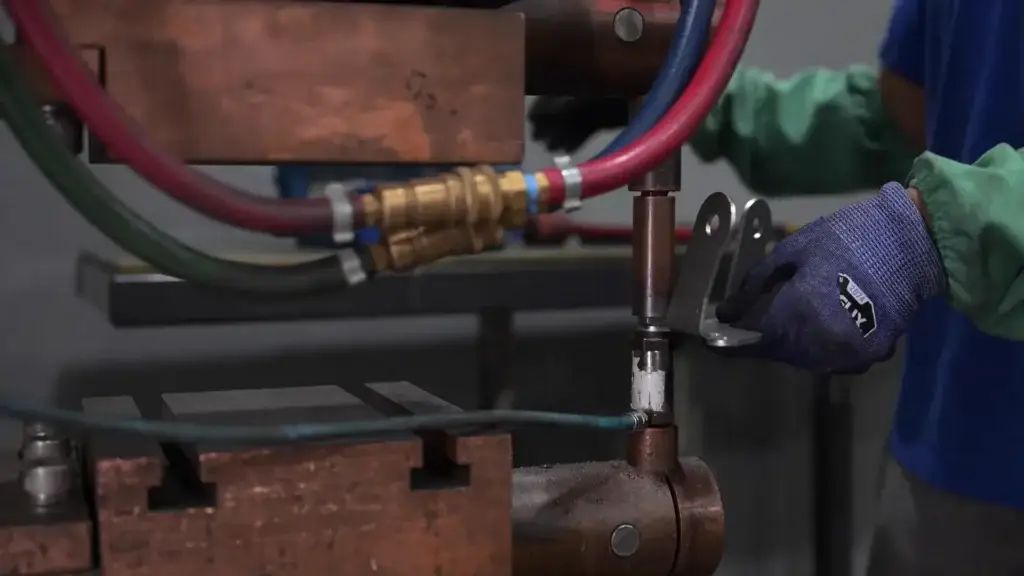
GSM’s resistance welders run in our South Bend, Indiana plant alongside our stamping presses, so weld nuts and studs are added to parts as they come off the line instead of being shipped out to another supplier. See the full equipment list.
| Machine | Capacity | Max. workpiece |
| Peer P-50 spot welder | 100 KVA | 17.5″ (450 mm) |
| Welding Technologies Corporation spot welder | 25 KVA | 27.5″ (700 mm) |
The 100 KVA Peer handles heavier-gauge spot and projection welds, while the 25 KVA welder covers lighter-gauge parts and larger workpieces.
Resistance Welding for OEM Production
Weld nuts, studs and spot-welded subassemblies are small details that stop an assembly line when they’re wrong. A missing nut, a cross-threaded fastener or a weak weld turns into a line-side repair at your plant.
GSM builds resistance welding into the same production flow as the stamping, so the part you receive is ready to bolt up. Our team works from your 2D drawings and 3D models, flags weld-access and fastener-placement issues during quoting, and runs every job to a documented process.
Weld Nuts Verified, Not Assumed
On weld-nut parts, GSM uses vision systems to confirm that the correct nuts are present and correctly sized, and that each part matches the customer’s 2D drawing before it ships. Paired with in-process checks of weld settings, this verification keeps missing or wrong fasteners from reaching your assembly line. Learn more about our quality systems.
What Is Resistance Welding?
Resistance welding joins metal parts by clamping them between copper electrodes and passing a high electric current through the joint. The metal’s resistance to that current generates heat right at the contact point, and electrode pressure forges the softened metal together into a solid weld nugget.
No filler wire, flux or shielding gas is needed, so the process is fast, clean and highly repeatable. That makes it a fit for sheet metal assemblies and fastener installation. Spot welding and projection welding are the two most common forms of resistance welding.
The Spot Welding Process
Resistance spot welding happens in four steps, often in less than a second:
- Clamp: Electrodes squeeze the overlapping sheets together with controlled force.
- Weld: Current flows for a fraction of a second, heating the interface until a weld nugget forms.
- Hold: Pressure is held while the nugget cools and solidifies.
- Release: Electrodes open and the part moves to the next weld or operation.
Projection Welding for Weld Nuts and Studs
Projection welding works the same way, but the heat is concentrated at small raised projections stamped or formed into one part, or built into the fastener itself. That’s how weld nuts and weld studs are attached. The projections locate the fastener, focus the current, and collapse under electrode force to form a strong, consistent joint, with several projections welded in a single cycle.
The GSM Approach
Because GSM builds the stamping dies, runs the presses and does the welding, we can design the weld into the part from the start. That means adding projections or locating features in the die, choosing between spot, projection and robotic MIG welding based on the joint, and planning fastener placement so electrodes can reach it. One team owns the part from blank to finished assembly.
GSM spot welds nuts onto cab components and dash panel assemblies for agricultural equipment and construction equipment manufacturers, where a missing fastener stops a line.
Spot Welding, Projection Welding & Weld Nut Installation
GSM matches the welding process to the joint, the material and the production volume.
- Resistance spot welding of overlapping sheet metal parts and brackets
- Projection welding of weld nuts, weld studs and stamped projections
- Weld nut installation on stamped and laser-cut parts, with vision verification
- Robotic MIG welding when a joint needs a continuous seam instead of spot welds
- PEM hardware insertion of self-clinching nuts, studs and standoffs when a fastener doesn’t need to be welded
- Assembly and kitting of welded components into ready-to-install subassemblies
High-Volume Projection Welding for Weld Nuts and Studs
For production programs, projection welding weld nuts directly to stamped parts removes loose hardware, secondary operations and a separate supplier from the supply chain. GSM pairs resistance welding with progressive and transfer die stamping, so high-volume parts like brackets, panels and mounting plates come off the line with their fasteners already installed and verified.
Why Manufacturers Choose GSM for Resistance Welding
OEMs choose GSM because resistance welding isn’t a standalone service here. It’s one step in a connected manufacturing process that includes tool and die, stamping, laser cutting, bending, robotic welding, machining and assembly. Fewer handoffs mean fewer quality escapes, shorter lead times, and one accountable partner for the finished part.
104 Years of Protecting Your Brand™
Resistance Welding, Made in the USA
Every part GSM welds is made in the USA, in South Bend, Indiana and Tomah, Wisconsin. Keeping stamping, welding and assembly together in the Midwest shortens shipping lanes, simplifies quality communication, and protects your program from overseas supply disruptions.
A Competitive Advantage
See how GSM tackles the toughest stamping and fabrication challenges in real time. Watch our team in action and see why leading OEMs trust us with their biggest projects.
Let's Build Something That Lasts
Need weld nuts, studs or spot-welded assemblies added to your stamped parts? Send us your drawings and we’ll recommend the right welding process and quote the complete part.
Frequently Asked Questions
Here’s what OEMs and manufacturers ask most often when they’re evaluating a spot welding and resistance welding partner.
What is the difference between spot welding and projection welding?
Spot welding joins overlapping sheets at points defined by the electrode tips. Projection welding concentrates current at raised projections on the part or fastener, which lets several welds form at once and is the standard method for attaching weld nuts and weld studs.
What is a weld nut?
A weld nut is a nut designed to be welded to a metal part, usually with small projections on one face that melt and fuse during projection welding. It creates a permanent threaded attachment point without a loose nut or access to the back side.
Is resistance welding strong?
Yes. A properly set resistance weld fuses the base metals into a solid nugget. GSM controls current, time and electrode force for each job and verifies weld-nut parts with vision systems.
What materials can be resistance welded?
Resistance welding works well on low-carbon steel, galvanized and coated steels, and stainless steel. Aluminum can be resistance welded but needs different settings and equipment. GSM will recommend the right process for your material.
Can GSM add weld nuts to parts it stamps or laser cuts?
Yes. Weld nuts and studs are most often installed on parts GSM stamps or laser cuts in-house, so the fastener is part of the finished component you receive.
When should I choose spot welding over MIG welding?
Spot welding is faster and adds no filler metal, which makes it ideal for overlapping sheet metal joints in volume. MIG welding is better for thick sections, fillet and butt joints, or seams that must be continuous. GSM offers both and will recommend the better fit.
Do you support prototype and low-volume welding?
Yes. GSM supports prototypes and short runs so you can validate fastener placement and weld design before scaling to production.
What file formats do you accept for quoting?
GSM accepts STEP, IGES, SolidWorks, Pro/E (Creo), AutoCAD (DWG/DXF), and PDF technical drawings.
Which industries does GSM spot weld parts for?
GSM spot welds weld nuts onto cab components and dash panel assemblies for agricultural equipment and construction equipment manufacturers, along with stamped brackets and assemblies for other OEM programs.
Can projection features be built into the stamping die?
Yes. Our in-house tool and die team designs and builds the dies, so projections and locating features for welding can be formed into the part during stamping.