If you’re sourcing stamped parts, volume drives almost every other decision you’ll make — tooling, supplier, price, and lead time. A part that needs 500 units a year and a part that needs 500,000 units a year are, functionally, two different manufacturing problems, even if the finished component looks identical on your print.
Low volume metal stamping isn’t a lesser version of production stamping — it’s a different strategy built around different tooling and different economics. Get the volume call wrong and you’ll either overpay for tooling you didn’t need, or underinvest in a process that can’t hold up once the order size grows. This guide covers how to tell the difference, how tooling strategy shifts as volume climbs, and how to think about total cost instead of just per-part price.
What “Low Volume,” “Medium Volume,” and “High Volume” Actually Mean in Stamping
These terms get used loosely across the industry, but they map to real production and tooling decisions:
Low volume / short run — roughly a few hundred to 10,000–20,000 parts per year. Covers prototypes, pilot runs, service/repair parts, and niche or low-mix products. Tooling is usually simple: single-station or soft/stage tooling, sometimes no hard die at all.
Medium volume — roughly 20,000 to 50,000 parts per year. The transition zone. Some programs stay on stage tooling; others are ready to justify a progressive die, especially for complex parts or multi-year programs.
High volume / production — above roughly 50,000 parts per year. Where hard progressive-die tooling earns its keep. GSM’s own guidance on its metal stamping services capability page puts it plainly: “Progressive die stamping is most cost-effective at annual volumes above 50,000 parts, where the tooling investment is offset by low per-part production cost.”
These thresholds aren’t hard rules — part complexity, material, and tolerance requirements can shift them — but they’re a solid starting point before you loop in a supplier.
How Tooling Strategy Changes with Volume
Tooling is where the volume decision actually shows up on your quote. At a high level, there are two ends of the spectrum:
Soft or stage tooling (sometimes called prototype or short-run tooling) uses simpler, less durable dies — often single-hit or single-station setups, or manual/hand-fed operations for features that would otherwise need a laser or press brake pass. It’s cheaper and faster to build, but produces parts more slowly and wears faster — the right tradeoff when the design isn’t final or the order doesn’t justify a bigger investment.
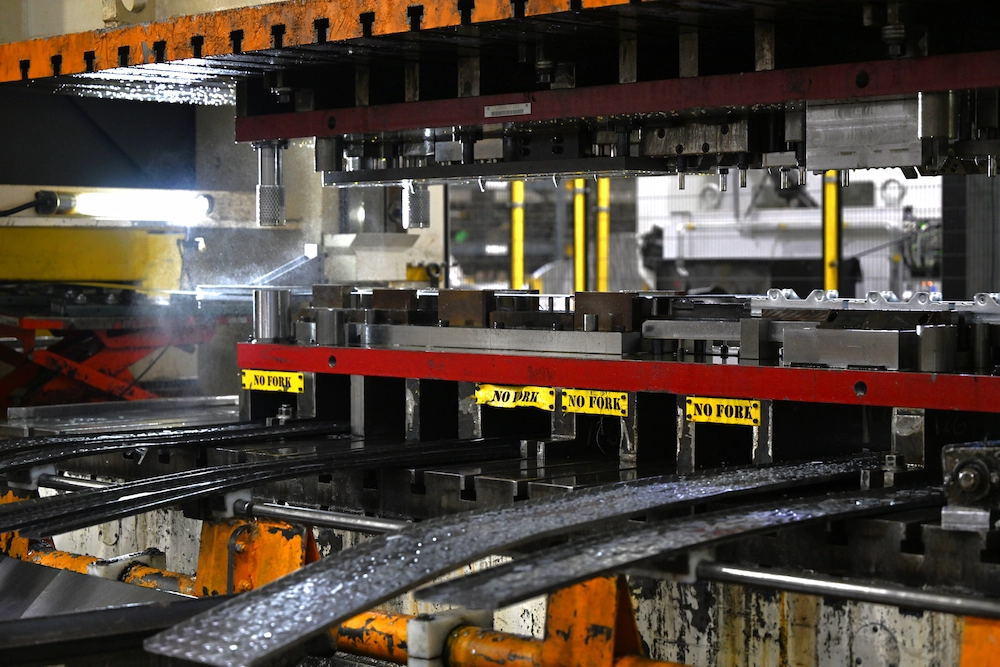
Hard progressive die tooling runs a strip of material through multiple stations in a single press stroke — piercing, forming, and cutting the part complete in one continuous pass. It’s a significant up-front investment (GSM’s tooling lead time runs 4 to 12 weeks, depending on die complexity, station count, and part geometry — simple dies can be built in as few as 5 weeks). But once it’s built, per-part cost drops sharply and cycle times run at production speed.
Here’s the conceptual math: divide the tooling cost across your expected annual volume. At low volumes, that per-part “tooling burden” stays high no matter how efficient the press is — you simply aren’t making enough parts to spread the investment thin. At high volumes, the same tooling cost becomes a rounding error on the unit price, and the cycle-time savings of a progressive die start to dominate the total. That crossover is exactly why the ~50,000-unit-per-year threshold exists: below it, soft tooling usually wins on total cost; above it, hard tooling usually wins.
When Low-Volume Stamping Beats Fabrication or Machining
Low order quantities don’t automatically mean you should default to laser cutting, machining, or manual fabrication instead of stamping. Stamping — even short-run stamping — is often the better call when:
The part needs stamping-specific features — coining, embossing, progressive forming, or deep-draw geometry — that a flat-pattern process like laser cutting can’t reproduce, no matter the quantity.
You expect the volume to grow. If a “prototype” part is a placeholder for a production part six or twelve months out, running it on a stamping process from day one (even with soft tooling) validates a design and process already suited to the eventual die build, instead of re-engineering a machined part into a stampable one later.
Repeatability across a mid-size run matters more than per-unit machining precision. Machining time scales linearly with volume in a way stamping doesn’t — even soft-tooled stamping starts to out-pace machining once you’re past a few hundred parts.
The part is sheet or coil stock in the first place. If the design already calls for a formed sheet-metal shape, stamping is the native process; fabrication and machining are workarounds.
Where fabrication or machining genuinely wins: true one-off prototypes with no path to volume, tight 3D tolerances stamping can’t hit economically, or designs still changing weekly. Laser cutting is often the right call for flat-pattern prototypes before final formed geometry is locked in.
Prototype-to-Production: How GSM Supports the Transition
The riskiest moment in a low-volume-to-high-volume program isn’t the first order or the biggest one — it’s the handoff between them. A part validated on soft tooling with one supplier and re-tooled for production with a different one means re-qualifying the design, material, and process from scratch.
GSM builds that transition into a single relationship instead of a supplier swap:
Every project starts with a free DFM (Design for Manufacturability) review. Our engineers evaluate progressive-die feasibility, flag cost-reduction opportunities, and return feedback within 24 hours — before you’ve committed to a tooling path.
We offer prototyping and short-run stamping services, using the same engineering team that will build out the production tooling later.
Tooling is designed and built in-house, so moving from a soft-tooled pilot run to a hard progressive die means picking up the same part file with a team that already knows it — not starting a new vendor relationship.
That continuity is the practical version of what we mean when we talk about Protect Your Brand™: a part that performs the same way on unit one and unit one-million, because the same team engineered both.
Total-Cost Thinking: Per-Part Price vs. Tooling Investment vs. Supply Risk
A quote that only compares per-part price will steer you wrong at any volume. Three variables belong in the comparison, not one:
Per-part price. The number every quote leads with — but it’s only accurate once you know which tooling tier it assumes.
Tooling investment, amortized over realistic volume. A lower per-part price backed by a bigger die investment only pays off if you actually hit the volume that justifies it. Ask suppliers to show tooling cost and per-part price separately, not blended.
Supply risk. What happens if volume comes in below forecast, a design change forces a die rework, or your only source for a critical part is an overseas tool room with weeks of freight stacked on top of build time? A domestic supplier with in-house tooling can turn around a die modification in days, not months — value that never shows up as a line item on the quote.
Decision Guide: Matching Volume to Approach
Annual volume band
Typical tooling approach
Best fit for
Watch out for
Prototype / very low (a few units – a few hundred)
No hard tooling, or single-hit soft tooling; laser cutting for flat patterns
Design validation, first-article approval, pilot builds
Don’t over-invest in tooling before the design is locked
Low volume / short run (hundreds – ~20,000/yr)
Soft or stage tooling, manual/hand-fed operations
Niche products, service parts, unproven-demand programs
Per-part cost stays high — budget for it
Medium volume (~20,000 – 50,000/yr)
Stage tooling or entry-level progressive die
Growing programs, multi-year contracts
Get a DFM review before committing to a die
High volume / production (50,000+/yr)
Hard progressive die tooling
Established programs, automotive/OEM production runs
Confirm forecast accuracy — a die built for the wrong volume is costly either way
FAQ
What’s considered “low volume” in metal stamping?
There’s no single industry-wide cutoff, but a few hundred to roughly 20,000 parts per year is generally considered low volume or short-run stamping. Above that, programs move into medium- or high-volume territory, where progressive die tooling starts to make sense.
Can GSM run a true low-quantity or prototype order, or is there a minimum order quantity?
Yes. GSM’s prototyping and short-run stamping services let you validate a design before committing to production tooling — progressive die tooling becomes cost-effective above roughly 50,000 units per year, and soft/stage tooling covers everything below that.
How long does it take to build progressive die tooling once we’re ready to scale up?
Typically 4 to 12 weeks, depending on die complexity, number of stations, and part geometry. Simple dies with fewer stations can be built in as few as 5 weeks.
If we start with a low-volume run, can we scale to high-volume production without switching suppliers?
Yes — that’s the transition GSM is built to support. With tooling designed and built in-house, the same engineering team that validates your prototype or short run can carry it into full progressive-die production, with no re-qualification and no new vendor.
Ready to Right-Size Your Stamping Program?
Whether you’re validating a prototype or scaling into full production, our team can help match tooling strategy to your actual volume — not the volume you hope for. Get a Quote and tell us where your program stands today.
General Stamping & Metalworks, Inc. South Bend Location
25101 Old Cleveland Rd
South Bend, IN 46628 574-288-0611 info@gsmwinc.comGeneral Stamping & Metalworks, Inc. Tomah Location
328 Cardinal Ave
Tomah, WI 54660 608-374-4769 info@gsmwinc.com

 Here’s the conceptual math: divide the tooling cost across your expected annual volume. At low volumes, that per-part “tooling burden” stays high no matter how efficient the press is — you simply aren’t making enough parts to spread the investment thin. At high volumes, the same tooling cost becomes a rounding error on the unit price, and the cycle-time savings of a progressive die start to dominate the total. That crossover is exactly why the ~50,000-unit-per-year threshold exists: below it, soft tooling usually wins on total cost; above it, hard tooling usually wins.
 Here’s the conceptual math: divide the tooling cost across your expected annual volume. At low volumes, that per-part “tooling burden” stays high no matter how efficient the press is — you simply aren’t making enough parts to spread the investment thin. At high volumes, the same tooling cost becomes a rounding error on the unit price, and the cycle-time savings of a progressive die start to dominate the total. That crossover is exactly why the ~50,000-unit-per-year threshold exists: below it, soft tooling usually wins on total cost; above it, hard tooling usually wins.