If you’re sourcing high-volume stamped parts, you’ve probably heard “progressive die” thrown around by every supplier you talk to — but not every supplier can tell you exactly why it matters for your program. This guide breaks down how progressive die stamping actually works, how it compares to transfer die and simpler stage tooling, and when the tooling investment pays off. For the full picture of GSM’s stamping capabilities, start with our
metal stamping services overview — this post goes deeper on one specific process inside it.
What Is a Progressive Die? How the Process Works
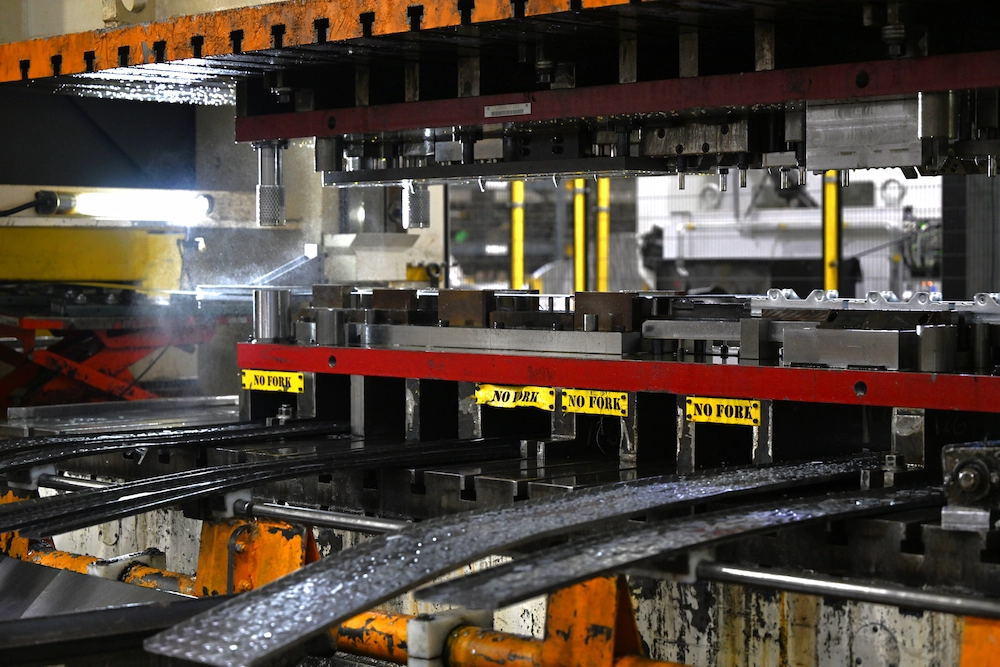
A progressive die is a single die set built with multiple stations in a row, mounted in one press. A coil of sheet metal feeds through the die, and the strip advances one station at a time — piercing, bending, coining, or forming a little more of the part at each stop. The part stays attached to the carrier strip for the entire run, only separating from the strip at the final station.
That’s the core distinction that matters for buyers: because the strip carries the part through every operation, progressive die tooling can hold tight, repeatable geometry across thousands of hits without an operator repositioning anything by hand. It’s why progressive die is the backbone of high-volume, high-repeatability stamped-part programs — brackets, clips, terminals, and structural components that need to look and measure identically at part 1 and part 1,000,000.
GSM runs progressive die stamping on presses up to 2,000 tons, producing parts that range from palm-sized components to structures stretching over 15 feet, on coil-fed lines built specifically for this kind of continuous, station-to-station production.
The Progressive Die Stamping Process, Station by Station
A typical station sequence runs pilot and pierce, then blank or notch, then form and draw, then restrike, then cut-off. Station count follows part complexity — a simple bracket may need six or eight, while a formed part with tight flatness callouts can run past twenty.
The throughput math is the part buyers most often get wrong. Every station fires on every stroke, so a twelve-station die does not produce one finished part every twelve strokes. It produces one finished part per stroke once the strip is fully fed. The first eleven strokes fill the die; after that, every hit yields a complete part. That is why progressive die economics improve so sharply with annual volume, and why press speed rather than station count sets your parts-per-minute.
Progressive Die vs. Transfer Die vs. Stage Tooling
Progressive die isn’t the only way to stamp a multi-operation part. Here’s how it stacks up against the two other common approaches:
|
Progressive Die |
Transfer Die |
Stage Tooling |
| How the part moves |
Stays attached to the carrier strip through every station, in one continuous die |
Separated from the strip at the first station, then mechanically transferred between independent die stations |
Moved manually (or with simple automation) between separate single-operation dies, often across different press hits |
| Best fit |
High-volume, high-repeatability parts with several formed features |
Larger or more complex parts that need to be handled individually between operations |
Low-volume runs, prototypes, and parts still being proven out before committing to full tooling |
| Tooling investment |
Highest upfront — one integrated, multi-station die |
High — multiple stations plus a transfer mechanism |
Lowest upfront — simple, single-operation dies |
| Per-part cost at volume |
Lowest, once volume is high enough to offset tooling cost |
Moderate |
Highest — more handling and press cycles per part |
| Typical part complexity |
Small to mid-size parts with multiple bends/features |
Larger, deeper-drawn, or more geometrically complex parts |
Simple geometries, or parts still in design iteration |
Stage tooling is the right call when a part hasn’t proven out yet, or when annual volume doesn’t justify a dedicated multi-station die. Transfer die earns its keep on larger or more intricate parts where handling the piece between stations — rather than carrying it on a strip — makes more sense mechanically. Progressive die wins when you need speed, repeatability, and the lowest cost per part at scale.
When Does Progressive Die Make Economic Sense?
Progressive die tooling costs more to build than transfer die or stage tooling for a comparable part — you’re paying for a fully integrated, multi-station die up front. That investment only pays off once per-part savings at volume outweigh it.
As a general guideline, progressive die stamping becomes cost-effective at annual volumes above roughly 50,000 units. Below that threshold, the tooling investment is harder to justify against a part’s total program life, and transfer die or short-run stage tooling usually pencils out better. Above it, the math flips: progressive die’s lower per-part cost and higher throughput start outrunning the upfront tooling spend fast, especially on multi-year OEM programs.
This is why the conversation with your stamping partner should start with volume and program life, not just part geometry. A part that looks simple on a print can still justify progressive tooling if you’re committing to 200,000 units a year for five years — and a geometrically complex part might still be better served by transfer die or stage tooling if your annual volume sits at 10,000 units. High-volume
automotive stamping programs are a classic example of the progressive-die economics playing out over a multi-year platform life — GSM runs welded assemblies of stamped bumper brackets at 100,000 units per year on progressive tooling, well above the threshold where the investment pays for itself.
Progressive Die Materials and Tolerances
GSM processes progressive die stampings in carbon steel, stainless steel, galvanized steel, aluminum alloys, copper, and self-healing zinc/aluminum/magnesium (ZAM) — the same material range used across our broader stamping capabilities.
Tolerance is where die design and engineering discipline show up. Standard tolerance on progressive die work is ±0.10mm; precision tolerance of ±0.05mm is achievable on critical dimensions, depending on material, part geometry, and die design. Hitting the tighter number consistently isn’t just about the press — it comes down to steel selection, coatings, clearances, radii, timing, and strip layout being engineered correctly from the start. Run speed depends on material: GSM’s progressive dies run 5/16″ Grade 80 steel components at 14 parts per minute, and 14-gauge Grade 50 steel components at up to 20 parts per minute.
What to Look for in a Progressive Die Partner
Progressive die tooling is only as good as the team that designs, builds, and maintains it. A few things worth asking any potential partner:
- Is tooling built in-house, or outsourced? Outsourced tool building adds a middleman — and a delay — every time a die needs a tweak during tryout or a repair mid-run. GSM’s in-house tool and die team includes nine journeyman toolmakers who design, build, and maintain progressive dies under the same roof as the stamping floor, so feedback between tooling and production happens in hours, not weeks.
- Do they offer DFM support before you commit to tooling? A design-for-manufacturability review can catch strip-layout or feature problems before steel is cut for the die — expensive mistakes to fix after the fact.
- What’s their tooling lead time, and does it match your launch schedule? Progressive die tooling typically takes 4 to 12 weeks depending on complexity, station count, and part geometry — build that into your program timeline early.
- Can they support the part if volume grows or changes? A partner who can move a part from stage tooling to a full progressive die as volume ramps saves you from re-sourcing mid-program.
Progressive Die Stamping — FAQ
How many stations does a typical progressive die have?
It varies with part complexity — a simple bracket might run through just a handful of stations, while a part with multiple bends, pierces, and forms can require well over a dozen. Station count is one of the biggest drivers of both tooling cost and lead time.
What’s the difference between a progressive die and a stage (single-operation) die?
A progressive die performs every operation in one integrated tool while the strip advances automatically. Stage tooling uses separate, single-operation dies, with the part moved between them by hand or simple automation. Stage tooling costs less upfront but carries more labor and handling per part — it’s a better fit for low-volume or not-yet-proven parts.
Can a part start on stage tooling and move to a progressive die later?
Yes, and it’s a common path. Parts often launch on stage tooling while volume is uncertain, then move to progressive die once annual demand clears the threshold where the tooling investment pays for itself.
What happens if a progressive die needs maintenance during a production run?
This is exactly where in-house tool and die capability matters. When the team that built the die is on-site, repairs and adjustments happen without waiting on an outside toolmaker’s schedule — GSM’s typical in-house turnaround for mid-run die maintenance is 4 hours, keeping your production run on track instead of stalled behind someone else’s queue.
Sourcing a part that might justify progressive die tooling? Talk to GSM’s team about volume, tolerances, and timeline before you commit to a die design.
Get a Quote →