If you’ve sourced metal parts before, you’ve probably heard “sheet metal stamping” and “sheet metal fabrication” used almost interchangeably — sometimes by the same supplier, in the same conversation. They’re not the same process, and the difference matters more than it sounds like it should. Pick the wrong one for your volume and part geometry and you’ll either overpay for tooling you didn’t need or bleed money on a per-part cost that should have dropped months ago.
We build both at GSM, which puts us in an unusual position: we don’t have to steer you toward whichever process happens to be sitting idle on our floor. This guide walks through what sheet metal stamping actually is, how it differs from fabrication, the materials and operations involved, and — most importantly — how to tell which one your part actually needs.
What Is Sheet Metal Stamping?
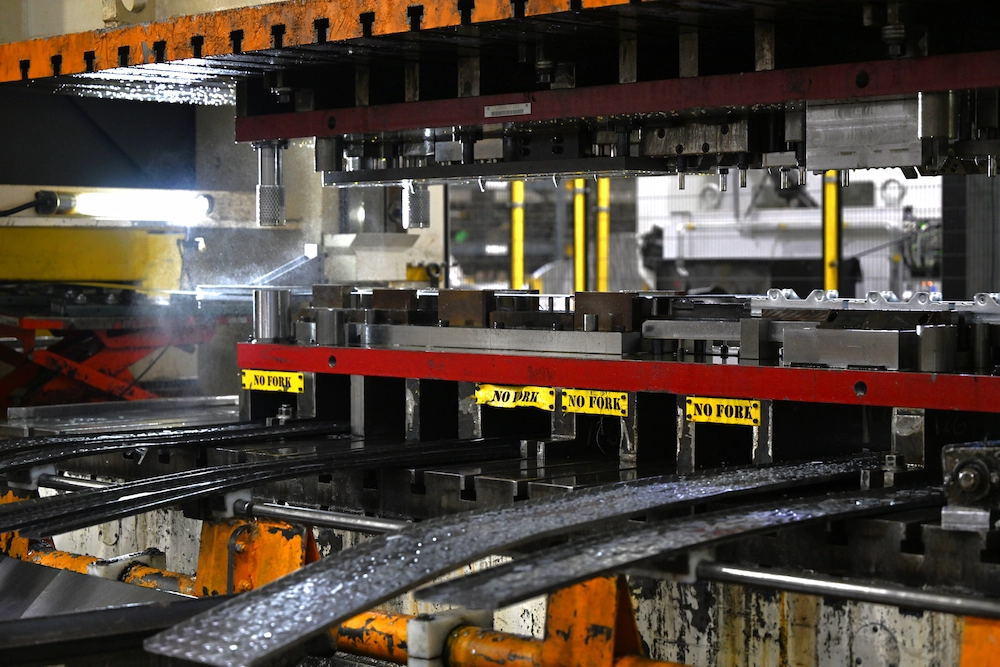
Sheet metal stamping is a high-speed, cold-forming manufacturing process that converts flat metal sheets or coils into a specific shape using high pressure inside a custom die. Our sheet metal stamping services run on presses up to 2,000 tons, forcing the sheet or coil stock through the die in a single stroke or a coordinated sequence of stations, producing parts at a rate of roughly 14 to 25 pieces per minute. Progressive stamping lines running coil-fed material can push that further, into the range of 800 to 1,100 parts per hour.
The defining trait of stamping is the die. Once it’s built, a stamped sheet metal part comes out virtually identical, stroke after stroke, run after run. That repeatability is the entire value proposition — and it’s also the catch, because building the die is a real up-front investment you need enough volume to justify.
Sheet Metal Stamping vs. Sheet Metal Fabrication: The Real Difference
This is the confusion we hear most often from sourcing teams, and it’s a fair one — “fabrication” gets used as an umbrella term for almost anything done to sheet metal. Here’s the distinction that actually matters for your quote:
- Sheet metal stamping uses a dedicated, part-specific die and a stamping press. It’s a tooled process: the geometry is built into hardened steel before the first good part ever comes off the line.
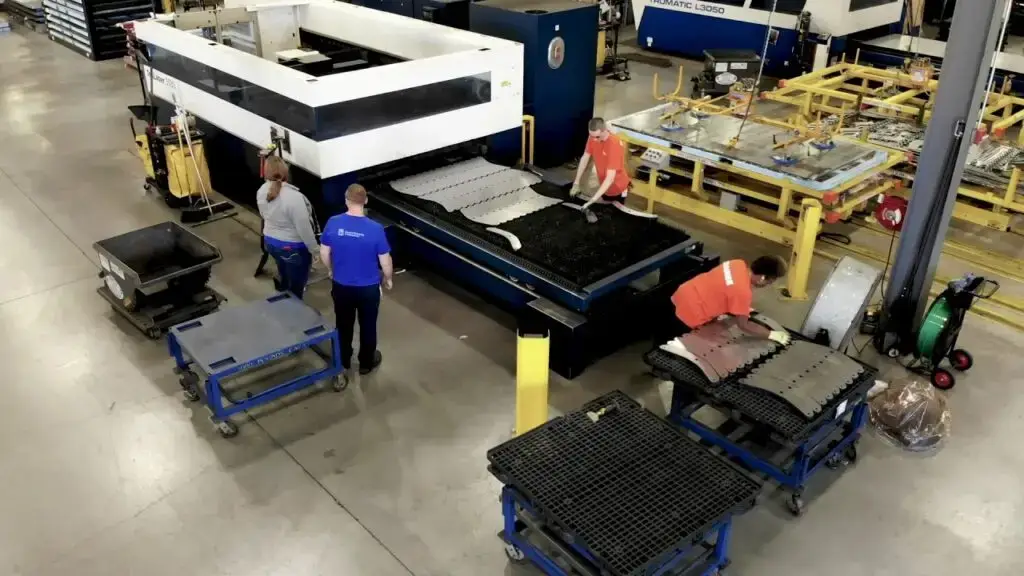
- Sheet metal fabrication — typically laser cutting and press brake bending — uses programmable, general-purpose equipment. A CNC laser cuts the flat pattern; a press brake forms the bends. No hard tooling, minimal setup, and a part can go from CAD file to first article in days rather than weeks.
Neither one is “better.” They’re optimized for opposite ends of the volume curve, and a capable partner should be telling you which one fits your job — not just running whichever process it happens to sell hardest.
Materials and Gauges We Run
GSM stamps and fabricates a wide range of sheet materials, each suited to different gauge ranges and end uses:
| Material | Typical grades | Gauge range | Standard |
|---|---|---|---|
| Aluminum | 5052, 6061-T6 | 0.032″–0.125″ | ASTM B209 |
| Cold rolled steel | CQ, DDS | 0.036″–0.125″ | ASTM A1008 |
| Stainless steel | 304, 316 | 0.038″–0.109″ | ASTM A240 |
| Hot rolled steel | CQ, HSLA | 0.134″–0.250″ | ASTM A1011 |
| Galvanized steel | G60, G90 | 0.060″–0.135″ | ASTM A653 |
| Galvanneal steel | A40, A60 | 0.061″–0.093″ | ASTM A653 |
Beyond these, our progressive die lines also run carbon steel, copper, and ZAM — a zinc-aluminum-magnesium coated steel increasingly specified where corrosion resistance and weldability both matter. Material and gauge selection drives tooling design, press tonnage, and cycle time, so it’s one of the first things our team locks down during quoting — well before a die gets cut.
Stamping Operations Applied to Sheet Metal
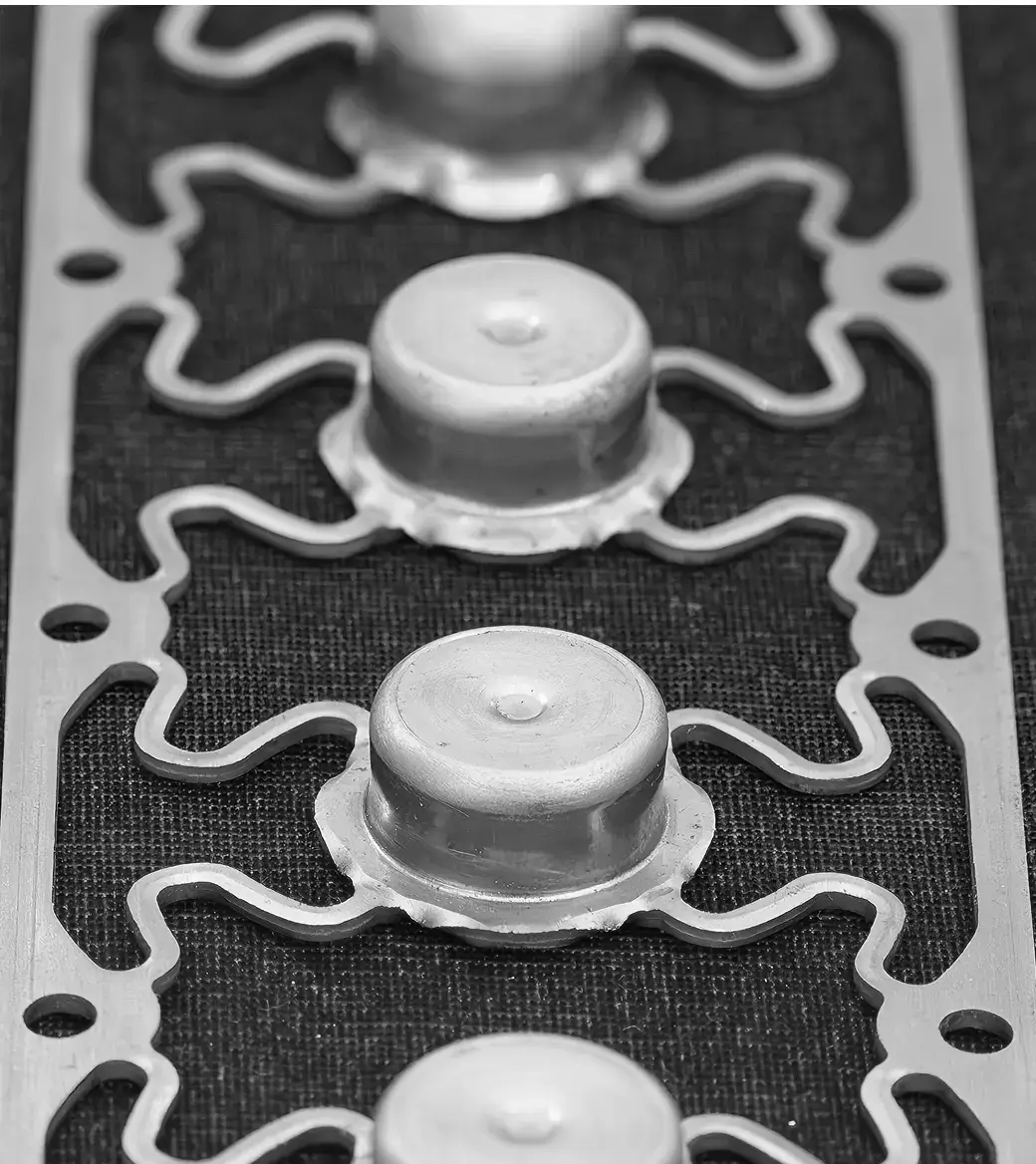
A single stamped sheet metal part is rarely the product of just one operation. Most progressive dies combine several of the following in one continuous strip:
- Blanking — cutting a flat piece to its outer profile from sheet or coil stock, the starting point for almost every stamped part.
- Punching — cutting internal features: holes, slots, cutouts.
- Bending — forming a flat blank along a line to create an angle, without stretching the material thin.
- Embossing — raising or recessing a shallow feature (a rib, a logo, a stiffening bead) without cutting through the metal.
- Flanging — bending a narrow edge, often at 90°, to add stiffness or create a mounting surface.
- Drawing — pulling flat stock into a three-dimensional cavity to form cups, boxes, or other non-flat shapes, one of the more demanding operations because the material has to stretch without tearing or wrinkling.
A progressive die can walk a single strip of coil stock through all six of these stations in sequence, so a finished part drops off the far end of the press fully formed — no secondary operations required.
When to Choose Stamping vs. Fabrication: The Volume Math
This is the question that actually decides your sourcing strategy, and it comes down to one thing: annual volume relative to tooling cost.
- Low volume, prototypes, frequent design changes: Fabrication wins. Laser cutting and bending need no hard tooling, so there’s no upfront investment to amortize — you pay a bit more per part, but you pay it starting on part one, and you can change the design between runs without scrapping a die.
- High volume, stable design: Stamping wins. As a rule of thumb, progressive die stamping becomes the more cost-effective route above roughly 50,000 parts per year — the point at which the die’s fully-loaded cost, spread across the run, drops the per-part price below what fabrication can match. Tooling lead time typically runs 4 to 12 weeks depending on die complexity (simple dies in as little as 5 weeks; complex multi-station progressive dies closer to 10–12).
- The middle ground: Plenty of parts don’t fall cleanly on either side. A part with moderate volume but complex forming (deep draws, tight flatness callouts) may justify tooling sooner than the 50,000-unit rule of thumb suggests, because fabrication struggles to hit the same repeatability. A supplier who runs both processes in-house — rather than one who only owns a laser and a brake, or only owns presses — is the one who can actually run this math honestly instead of defaulting to whatever they already have on the floor.
Design Considerations for Stamped Sheet Parts (DFM)
Getting a stamped part right the first time comes down to designing it for the process, not just the finished shape. Considerations our engineering team walks through on every quote include:
- Consistent wall/wall and material thickness across the part — stamping doesn’t add material, so features that assume varying thickness need to be rethought.
- Generous bend radii relative to material thickness, to avoid cracking at the bend line.
- Adequate hole-to-edge distance so punched features don’t distort the blank’s outer profile.
- Rounded internal corners instead of sharp ones, which concentrate stress and shorten die life as well as part life.
- Draft and radius allowance on drawn features, so the metal can stretch into the die cavity without tearing or wrinkling.
- Springback allowance, since formed metal relaxes slightly after the press opens — tooling has to be cut to compensate.
- Grain direction, particularly on tight bends, since bending across the grain resists cracking better than bending with it.
We offer a free DFM (Design for Manufacturability) review on every quote, with feedback typically returned within 24 hours — catching these issues before a die gets cut is a lot cheaper than catching them after.
Industries and Example Parts
Stamped sheet metal parts show up anywhere a manufacturer needs a consistent, repeatable metal component at volume. GSM supplies stamped and fabricated sheet metal parts across agricultural equipment, automotive, construction equipment, data centers, material handling, military & defense, outdoor power equipment, recreational vehicles, solar & energy storage, and steel cabinetry & enclosures.
Typical part families include structural brackets, mounting plates, enclosure panels, chassis components, clamps and couplers, and stiffened panels that rely on embossed or flanged edges for rigidity without adding weight or a second part. If you’re sourcing for agricultural equipment manufacturers, the same volume logic above applies — high-run structural components are strong stamping candidates, while low-volume or seasonal-variant parts are often better served by fabrication.

Frequently Asked Questions
My part could go either way — how do I actually decide between stamping and fabrication?
Start with annual volume against tooling cost, not the part drawing. Below roughly 50,000 parts a year, fabrication usually wins on total cost because there’s no die to amortize. Above that, stamping usually wins on per-part cost and repeatability. For the fuller process-by-process comparison — cold vs. hot stamping, and how both stack up against casting or forging — see GSM’s metal stamping process guide.
Does sheet metal stamping always run from coil stock, or can it start from pre-cut blanks?
Both. Progressive dies are typically fed by coil so the strip moves continuously through blanking, forming, and cutoff stations without stopping — that’s how we hit 800–1,100 parts per hour. Lower-volume or single-station dies can instead run from pre-cut blanks, which trades some throughput for a smaller upfront tooling investment.
How many parts do I need before stamping makes sense instead of fabrication?
As a general guideline, progressive die stamping becomes the more cost-effective option above roughly 50,000 parts per year, once the die’s cost is factored into the per-part price. Complex geometry or tight tolerance requirements can shift that threshold lower.
Do you provide design support before we commit to tooling?
Yes. Every quote includes a free DFM review, with our engineering team returning feedback within 24 hours — before any die is cut.
Get a Quote
Whether your part is ready for a progressive die or still needs a few fabrication runs before it gets there, our engineering team can tell you which process actually fits — and price both so you can compare. Get a quote and we’ll get back to you with next steps.